
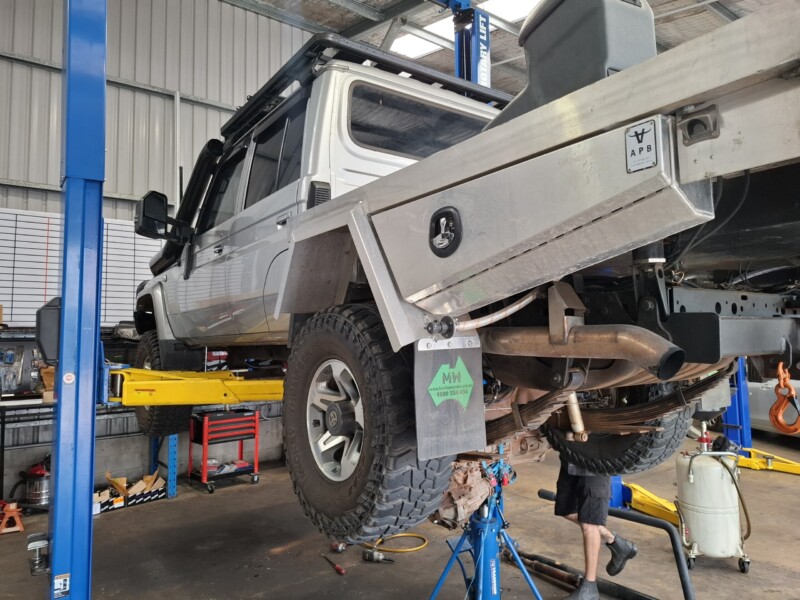
Today at AutoSavvy Mechanical, we have a 2020 Toyota LandCruiser 79 Series Dual Cab tray-back ute in the workshop for a clutch replacement.
This isn’t your average 79 Series.
This LandCruiser works hard. It regularly undertakes heavy towing and is also used to tow a 7-metre plate alloy boat, including getting the boat and trailer onto sand.
That type of work places enormous demands on the clutch, gearbox and entire driveline.
For this vehicle, fitting another standard replacement clutch simply wouldn’t make much sense. We’re fitting an NPC Super Heavy Duty Organic 1600 Clutch & Flywheel Package, specifically designed for demanding 4WD, towing and high-load applications.
Why towing is so hard on a clutch
A clutch has a relatively simple job: it has to smoothly transfer the engine’s torque to the gearbox while allowing the driver to disconnect the engine from the driveline when changing gears or coming to a stop.
Under normal driving conditions, that’s not particularly difficult.
Heavy towing is another story.
When a LandCruiser is pulling a large boat and trailer, particularly from a standing start, the clutch has to deal with significantly greater loads.
The situation becomes even more demanding when:
- The vehicle is heavily loaded
- A large trailer or boat is attached
- The vehicle is being driven on sand
- The driver is manoeuvring slowly
- The vehicle is starting on an incline
- Low-range 4WD is being used
- The trailer is difficult to move
- The clutch is required to slip while the vehicle gets moving
Every time the clutch slips, heat is generated.
The more load there is, the more heat the clutch has to absorb.
Repeatedly doing this can eventually cause clutch wear, glazing, overheating and loss of clamping ability.
Sand is particularly demanding
Towing a large boat on a hard road is one thing.
Towing it onto sand is something completely different.
Sand creates enormous rolling resistance. The vehicle needs considerably more torque to get moving, and there are often situations where the driver needs to control the vehicle at very low speed while maintaining enough engine torque to keep the vehicle moving.
This is exactly where a clutch can be subjected to severe heat and load.
A clutch that is perfectly adequate for a vehicle used primarily for commuting and occasional towing may not be the right choice for a working 4WD that regularly pulls heavy loads.
More than just a “stronger clutch”
When people hear the term heavy-duty clutch, they often think it simply means a clutch with a stronger pressure plate.
There is considerably more to it than that.
The clutch, friction material, pressure plate, flywheel and release system all have to work together.
The NPC Super Heavy Duty system we’re fitting to this LandCruiser is supplied as a matched clutch and flywheel package rather than simply using a replacement clutch on the original flywheel.
NPC’s Super Heavy Duty system uses a dedicated billet steel flywheel and a purpose-designed clutch assembly. NPC says its Super Heavy Duty range can provide substantially increased clamp pressure compared with a standard clutch, while still being designed to retain good drivability.
For a vehicle doing serious towing, that matched approach is important.
Why the flywheel matters
The flywheel isn’t just something the clutch bolts onto.
It forms one of the major friction surfaces of the clutch system and plays an important role in absorbing and managing heat.
A damaged, glazed or incorrectly machined flywheel can compromise a brand-new clutch.
That’s why replacing the clutch isn’t simply a matter of removing the old clutch, bolting in a new one and sending the vehicle back onto the road.
The flywheel surface, clutch alignment, release system and hydraulic operation all need to be correct.
With this NPC package, the dedicated flywheel is designed to work with the supplied clutch as a complete system.
Why we chose an organic clutch
There are many different types of performance and heavy-duty clutch materials available.
For a working 4WD that spends its life towing, we don’t necessarily want an aggressive competition-style clutch.
The vehicle still needs to be pleasant to drive.
An organic clutch can provide a useful balance between strength, durability and smooth engagement.
That’s particularly important for a vehicle that may spend Monday towing a heavy trailer and Tuesday being driven around town.
The goal isn’t simply to fit the most aggressive clutch available.
The goal is to fit a clutch that’s appropriate for the way the vehicle is actually used.
The NPC 1600 package being fitted today
The particular package being installed in this 2020 LandCruiser 79 Series is the:
NPC Super Heavy Duty Organic 1600 Clutch & Flywheel Package
It is listed by NPC specifically for the Toyota LandCruiser VDJ76, VDJ78 and VDJ79 equipped with the 4.5-litre 1VD-FTV V8 turbo-diesel engine.
The package includes:
- 325 mm clutch plate
- Super Heavy Duty clutch assembly
- Dedicated billet steel flywheel
- Concentric slave cylinder
- Spigot bearing
- Clutch alignment tool
NPC lists a calculated maximum dyno figure of 1600 Nm at the flywheel for this package.
That doesn’t mean a vehicle should routinely be operated at 1600 Nm, but it demonstrates just how substantial the clutch system is compared with a conventional replacement clutch.
A heavy-duty clutch can be an investment in reliability
A clutch replacement on a LandCruiser 79 Series isn’t a small job.
The gearbox and associated components have to be removed to access the clutch, so the labour involved is significant.
For a vehicle that works hard, fitting a clutch that is barely adequate for the application can be a false economy.
If the vehicle regularly tows heavy trailers, carries substantial loads or operates in difficult conditions, it makes sense to consider the entire application rather than simply asking:
“What clutch fits this vehicle?”
The better question is:
“What clutch is appropriate for the work this vehicle actually does?”
That’s an important distinction.
Signs that a towing vehicle’s clutch may be struggling
Some common warning signs include:
- Engine RPM increasing without a corresponding increase in road speed
- Clutch slipping under heavy acceleration
- Burning clutch smell
- Difficulty getting the vehicle moving under load
- Shuddering when taking off
- A clutch pedal that feels different from normal
- Difficulty selecting gears
- Excessive clutch engagement point
- Problems becoming more noticeable when towing
A clutch doesn’t always fail suddenly.
Often, it gives warning that its ability to handle the load is diminishing.
Don’t forget clutch break-in
A new heavy-duty clutch still needs to be treated correctly.
Even though a clutch may be designed for very high loads, the friction surfaces need time to bed together properly.
NPC recommends approximately 1,000 km of normal driving to bed the clutch in, with regular gear changes and around-town driving helping the clutch surfaces to settle. Hard use, burnouts and flat changes should be avoided during this period.
That’s particularly important with a vehicle that is going straight back to serious towing duties.
The right clutch for the job
The Toyota LandCruiser 79 Series has earned an excellent reputation as a working 4WD, but even a LandCruiser has limits.
When a vehicle is regularly towing heavy loads, launching or retrieving a boat, working on sand or carrying substantial weight, the clutch is one of the components that deserves careful consideration.
For this particular 79 Series, which spends its time towing a large 7-metre alloy boat and working in demanding conditions, a Super Heavy Duty clutch and flywheel package is a much more appropriate solution than simply replacing the original clutch with another standard unit.
At AutoSavvy Mechanical, we don’t just look at what part fits a vehicle.
We look at how the vehicle is used.
Because when it comes to a hard-working 4WD, the best clutch isn’t necessarily the cheapest clutch.
It’s the one that’s strong enough for the job.