
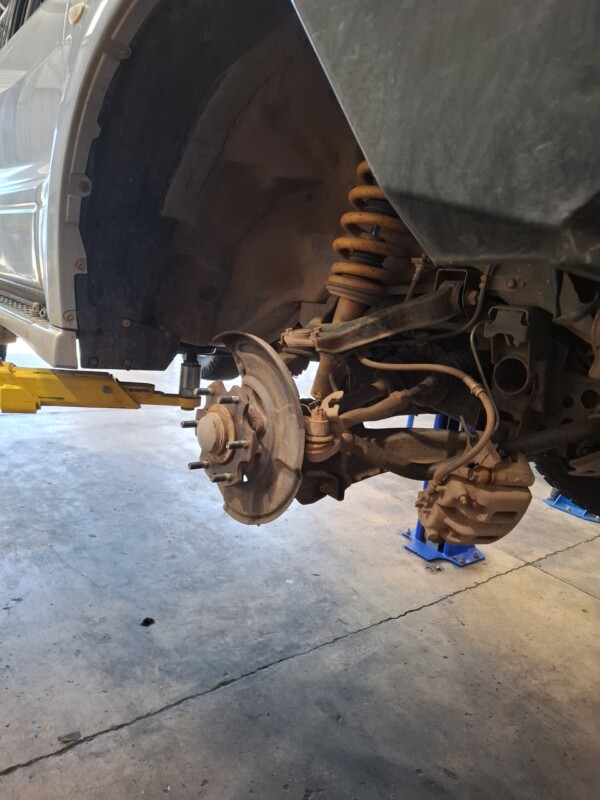
A routine service uncovered a potentially serious problem on a 2004 Mitsubishi Pajero halfway around Australia.
When you own a four-wheel drive and you’re travelling around Australia, it’s easy to concentrate on the things you can see.
You check the tyres.
You look for oil leaks.
You check the coolant and engine oil.
You listen for strange noises.
You might even take a quick look underneath the vehicle before heading off on the next leg of the journey.
But what about the things that are wearing out quietly?
Recently, a 2004 Mitsubishi Pajero LWB diesel wagon with around 400,000 kilometres on the clock came into Autosavvy Mechanical for what appeared to be a fairly straightforward service.
The Pajero was also halfway through a lap of Australia, making the condition of the vehicle particularly important.
While the engine oil was draining, our technician carried out the vehicle inspection.
That’s when we found something the owner couldn’t see from the driver’s seat.
A little bit of movement that shouldn’t have been there
During the inspection, our technician checked the front wheels and detected play in the right-hand front wheel.
It wasn’t something that would necessarily have been obvious to the driver.
There wasn’t a dramatic grinding noise.
There wasn’t a warning light on the dashboard telling the driver to stop.
And with the driver’s window down, listening to the sounds of the road while travelling along an Australian coastal highway, a developing wheel bearing can easily be masked by tyre noise, wind noise and the general sounds of a long-distance journey.
But the movement was there.
Further inspection identified a badly worn right-hand front wheel bearing assembly.
We contacted the owner, explained what we’d found and recommended replacing it before the Pajero continued its journey.
The owner gave us the go-ahead, and the bearing was replaced.
Why wheel bearings matter
Wheel bearings aren’t one of those components most drivers think about every day.
They’re hidden behind the wheels, doing their job quietly every time the vehicle moves.
But they’re carrying the weight of the vehicle while allowing the wheel and hub assembly to rotate smoothly. They also have to cope with braking forces, cornering forces, bumps, corrugations and everything else an Australian touring vehicle encounters.
On a four-wheel drive that’s travelled 400,000 kilometres, and is currently doing a lap of Australia, those components have certainly earned their keep.
And they’re not something you want to discover has deteriorated when you’re several hundred kilometres from the nearest workshop.
The noise you might not notice
One of the tricky things about wheel-bearing wear is that it doesn’t necessarily announce itself with a dramatic noise.
A worn bearing can produce a humming, rumbling or growling sound that increases with vehicle speed.
But there are plenty of other noises happening inside a four-wheel drive.
Tyres can hum.
Roof racks can whistle.
Wind noise can increase at highway speeds.
The road surface changes.
And when you’re travelling along the coast with the window open, there can be a surprising amount of background noise.
A driver can therefore become accustomed to a very subtle rumble and simply assume it’s part of the vehicle.
That’s why physical inspection is so important.
In this case, the significant clue wasn’t a noise reported by the owner.
It was movement detected by our technician while the vehicle was on the hoist.
The inspection happened while the oil was draining
This is one of the things we think is worth highlighting.
The Pajero didn’t come into Autosavvy Mechanical specifically because the owner thought there was something wrong with the wheel bearing.
It came in for an Oil and Filter change.
While the vehicle was already on the hoist and the engine oil was draining, our technician used that time to inspect the vehicle.
That inspection identified a problem that may otherwise have remained unnoticed.
This is one of the advantages of having a vehicle properly inspected during a service.
A service isn’t just about removing the old oil and installing new oil.
It’s also an opportunity to look at the vehicle as a whole.
Tyres.
Brakes.
Steering.
Suspension.
Wheel bearings.
Leaks.
Driveline components.
Belts and hoses.
And all the other components that have to work together to keep the vehicle safely moving down the road.
Especially important when you’re touring Australia
For a vehicle travelling around Australia, preventative inspection becomes even more important.
A problem discovered in your local workshop is inconvenient.
A problem discovered halfway across the Nullarbor, on a remote section of the Queensland coast, or hundreds of kilometres from the nearest town is a very different proposition.
That doesn’t mean every component needs replacing simply because a vehicle has high kilometres.
Quite the opposite.
The goal of a good inspection is to identify what is healthy, what is wearing, and what needs attention now.
That allows the owner to make an informed decision before a relatively manageable repair becomes a much bigger problem.
400,000 kilometres — and still going
There’s also something pretty impressive about this particular Pajero.
At around 400,000 kilometres, it’s still out there touring Australia.
That’s a lot of kilometres.
And it’s a reminder that high kilometres don’t necessarily mean a vehicle should be retired.
They do mean that regular maintenance and inspection become increasingly important.
Parts wear out.
Bearings wear.
Bushes deteriorate.
Seals eventually leak.
Hoses age.
Brakes wear.
None of that means the vehicle has reached the end of its useful life.
It means you need to know what’s happening underneath it.
Sometimes the important problems are the ones you don’t notice
The owner of this Pajero came in expecting a basic service.
They left with a new front right wheel bearing and, importantly, the knowledge that the vehicle had an issue that needed attention before continuing its Australian adventure.
That’s exactly why we inspect vehicles while they’re in the workshop.
Because sometimes the most important thing we find isn’t the problem you’ve brought the vehicle in for.
It’s the problem you haven’t noticed yet.
If you’re planning a long trip around Australia, or your 4WD has been doing the hard kilometres, have it inspected before you head off. A few minutes spent checking the vehicle on the hoist could uncover something you wouldn’t know was there from behind the wheel.
Autosavvy Mechanical — Noosaville
Professional servicing, inspections and repairs for cars and 4WDs.
by Jeremy Bycroft
Share
Share
Leave A Comment
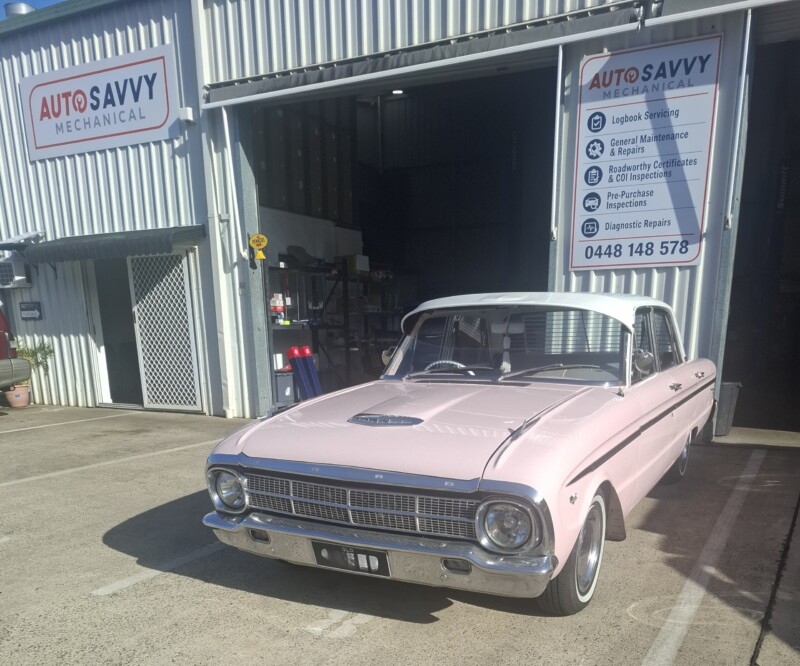
A beautiful 1964 Ford Falcon is getting a major suspension and steering overhaul at AutoSavvy Mechanical. At 62 years young, this classic proves some cars really are built to last.